SELECTION OF QUESTIONS AND ANSWERS
JUNE 2015 PART 2
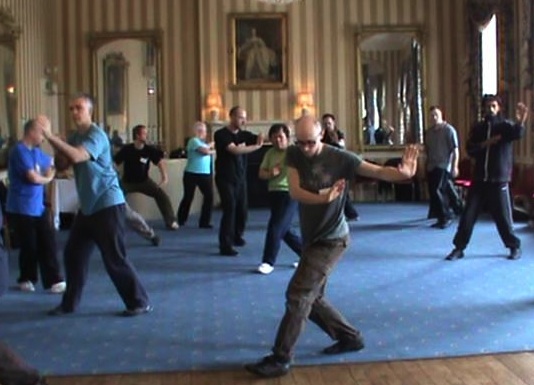
A historical Baguazhang course at the UK Summer Camp 2012
Question 1
I've been reviewing some videos to further increase my knowledge of what the world thinks about Baguazhang and recently saw a few Baguazhang weapons videos.
— Fredrick Chu, USA
Answer
What you are doing will contribute much to your understanding and attainment in Baguazhang. But it is important to know that what the world thinks of Baguazhang and what videos show on Baguazhang weapons may not be what Baguazzhang and Baguazhang weapons really are. This awareness is even more important in many other styles of kungfu chi kung and spiritual cultivation.
Indeed, it is shocking how much kungfu, chi kung and spiritual cultivation have deviated from their original purposes and practice as shown in what the world thinks of these arts, and in what videos, even by well known world masters, show these arts to be.
What the world thinks of kungfu is often represented by Bruce Lee, despite the fact that Bruce Lee rejected both kungfu philosophy and methodology. For example, Bruce Lee thought that stance training, which forms the foundation of all kungfu, was ineffective, and his training methods were precisely what traditional kingfu masters warned against.
If you examine videos showing free sparring amongst kungfu practitioners, with the exception of those from Shaolin Wahnam, virtually all of them use boxing and kick-boxing, with hardly any kungfu techniques. If you watch videos on kungfu weapons, again with the exception of those from Shaolin Wahnam, there are hardly any on using kungfu weapons in combat, which is precisely the reason why the weapons are for.
If you watch videos on the demonstration of a Guandao, or the Knife of Guan, which is a long, heavy weapon, you will see that the controlling hand of most demonstrators holds the weapon just below its blade, and that the blade of the weapon is flimsy, which negate its advantage of being a long weapon, and a heavy weapon. Holding the weapon just below its blade would not enable its practitioner to use it on horseback or to cut it through the armour of an opponent, which were precisely what a Guandao was for.
Question 2
One of the weapons that many people mention when discussing Baguazhang is the Deer Horn Knife (I've also heard them called the Meridian Knives and the Mandarin Duck Knives). I have to admit, the weapons look rather spectacular, having many cutting edges and sharp points.
I was wondering what are the special characteristics of the Deer Horn Knives? How do they enhance Baguazhang practice? Are certain weapons more conducive to enhancing or bringing out the best of Baguazhang, such as the straight sword, the single knife, or the huge "Bagua dadao"?
Answer
The Dear Horn Knives are so named because diagrammatically they resemble the antlers of a stag. They are also called Meridian Knives and Mandarin Duck Knives because they are always used in pair.
Indeed, they look spectacular. The weapons are just sharp edges and points.
The special characteristics of the Dear Horn Knives are its sharp blades and points, which make them highly destructive. It is almost impossible for an opponent to dislodge the weapons from the exponent. The horns of the weapons can be used to lock or capture an opponent’s weapon.
Any hit of the weapons will cause bloodshed. The main techniques are cutting, slicing and piercing.
Interestingly, while the Deer Horn Knives are closely associated with Baguazhang, their training does not enhance Baguazhang practice. Circulating the hands round the body is a special feature of Baguazhang, but the sharp blades and points of the Deer Horn Knives do not facilitate this feature. But the agility of Baguazhmg contributes to an effective application of these weapons, so long as the exponent does not circulate the weapons round his body and cut himself.
The straight sword is the most conducive in bringing out the best in Baguazhang, and vice versa. In both the sword and Baguazhang, agility and flowing movement are of utmost importance. The swordsman, however, must not use his sword to circulate round his body like what a Baguazhang exponent does with his hands.
The Single Knife, or sabre, is also conducive in bringing out the qualities in Baguazhang, and vice versa. Circulating the sabre or the arms round the body is a frequently used skill in sabre and Baguazhang performance and application.
The huge Bagua Dadao is a large sabre that is quite out of size. Because of its huge size, it is good for training internal force or mechanical strength for those who have no internal force. Personally, I do not favour it because its excessive large size distract its application as a sabre
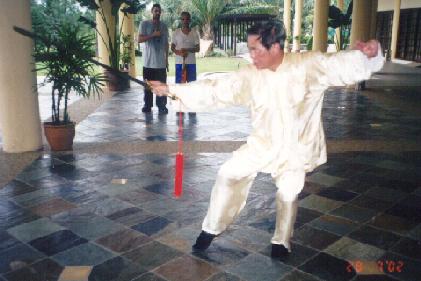
Grandmaster Wong performing the straight sword
Question 3
About a week or two ago, I felt the "false breakthrough" of the Small Universe during Baguazhang Circle Walking. It was the first time that I've clearly felt energy flowing through meridians (normally, my energy feels more diffuse or like waves passing across my body). I was walking the circle and my posture aligned in such a way that I began clearly feeling pockets of energy flowing along the Small Universe circuit.
I was wondering if Baguazhang, or any other particular martial arts, particularly well known for achieving the Small Universe and Big Universe?
Answer
Congratulations for your break-through of the Small Universe, even though it is "false" or apparent, and not "real" or permanent. A "false break-through" does not mean it is only an illusion and that there is really no break-through.
The term "false" is used relative to "real". A "false break-through" does not mean there is no break-through. It occurs when a bubble of energy goes round the Ren and Du Meridians, and the defilements that block the meridians are being pushed through by the bubble of energy, but they may resume their blockage after the bubble has gone through.
A "real break-through" occurs when the Du and Ren Meridians are fully filled with energy flowing continuously and harmoniously round the meridians. A real break-through of the Small Universe enables practitioners to live beyond a hundred years.
Baguazhang being an internal art is more suitable than many other kungfu styles for attaining a Small Universe. But only Baguashang masters who have practiced for many years may have this attainment. It will be faster if they learn the art of Small Universe separately. But Baguashang practitioners who practice only the external aspects of Baguazhang will never attain the Small Universe.
If all other things were equal, Wudang Taijiquan and Dragon Strength would be more effective than Baguazhang to attain the Small Universe. This is because the internal force in these two arts is more flowing than that in Baguazhang.
Your attaining a break-through of the Small Universe, even a “false’ one, is remarkable. Congratulations. Such an attainment is not likely to happen in most other schools.
Question 4
Also, I remember hearing from Sifu that Reverse Breathing is an important part of Small Universe training. I do know that at some point I would like to open the Small Universe, thanks to you and sifu writing about its amazing benefits.
I learnt Reverse Breathing at Goat Stance from my old Taijiquan sifu, and I had some good benefits like beginning to build and store energy at my dan tian, but I haven't practiced it in a long time (mostly because shortly thereafter, I learnt from you and Sifu in Florida).
Would it be worthwhile for me to begin practicing Reverse Breathing at Goat Stance if I wanted to further pursue the Small Universe, or should I wait until I'm able to spend a fair amount of time with you or Sifu (for example, at a Small Universe course) to learn how to attain the Small Universe?
Answer
Reverse Breathing is an advanced art. It should be learnt from a competent teacher as wrong practice can cause serious problems.
When I was learning the Small Universe from my sifu, Sifu Ho Fatt Nam, I made a mistake unknowingly while practicing Reverse Breathing. My chi accumulated about an inch on one side of my dan tian (I can’t remember now whether it was on the left side or the right side). It took me about three months of remedial exercise to correct it.
Many people mistake Reverse Breathing as Chest Breathing. They are different, though they look alike. In both cases, a practitioner’s chest rises as he breaths in. It rises more in Chest Breathing than in Reverse Breathing.
But in Chest Breathing it is air that goes into the chest. In Reverse Breathing it is energy, not air, that goes into the dan tian, or flows in a small universal circuit.
You should not attempt Reverse Breathing on your own. You can learn it from your sifu if you spend a fair amount of time with him, or learn it from me at a Small Universe course.
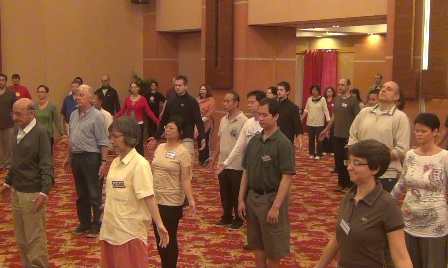
A Small Universe Course where participants attain a "real break-through"
Question 5
I was talking with Sifu recently and he told me that at my level, I really needed to begin practicing regularly with other people to further refine my sparring and fighting skills. Funnily enough, shortly after the Legacy of Wong Fei Hoong Summer Camp (which I was unfortunately unable to attend), I was lucky enough to find a good school of Hoong Ka Kung Fu.
One of the things I liked immediately was the fact that the school does a lot of Asking Bridge in preparation for free sparring. Even though I haven't had more than a handful of opportunities to train with and spar with people in the past two years, my stances, footwork, and internal force served me very well; I was routinely driving back and out-flanking people who had been in this school for about four or five years. The sifu complimented me on my solid stances and how my footwork always seemed to cut off my partner's avenues of escape. I wanted to thank you again for teaching me those skills in Baguazhang, they are coming in handy a lot here!
Answer
This is no surprise because we pay a lot of attention on stances and footwork, but many other schools don't. And Baguazhang is well known for footwork.
Question 6
I did have a question about Asking Bridge and "bridging" in general. I noticed that this school and many others (which I've seen mostly in documentaries and on YouTube) use the One Finger Zen hand-form (which they call "Bridge Hand") and their forearms for initially contacting with an opponent's arms, especially during or immediately after defending against a strike.
What is it about this hand-form that makes it so popular in Hoong Ka schools compared to, say, the thread hand, Tiger Claws, or open palms? I personally feel more comfortable and sensitive with the thread-hand and open palms, but that may just be my Baguazhang background.
Answer
"Bridge Hand" or "kiew sau" in Chinese (Cantonese) refers to the forearm, not the One-Finger Zen hand form. The forearm is called a "bridge" because it is the part that is usually in contact with an opponent.
The term “Bridge Hand’ is usually used in Hoong Ka Kungfu, and other styles derived from Southern Shaolin. It is seldom used in internal arts like Taijiquan, Baguazhang and Xingyiquan, or styles derived from Northern Shaolin like Praying Mantis, Tantui and Wuzuquan.
Besides in our school, the One-Finger Zen hand form, which is different from "Bridge Hand", is now found mainly in Hoong Ka Kungfu, and rarely in other kungfu styles. It is mainly used to develop internal force, and at advanced levels for dim mark, i.e. dotting energy points. However, I suspect that most students today just perform the external form of One-Finger Zen hand form without knowing its inner significance.
I once asked my sifu, Sifu Ho Fatt Nam, why the One-Finger Zen hand form was used to develop internal force. He told me that it activated the lung meridian. I followed up asking why was the lung meridian in particular activated in developing internal force. He said, in Cantonese, "fai wei hei zi fu", which in Englsih means the lungs are the organs for energy. As developing internal force needs flowing energy, activating the lung meridians using One-Finger Zen is a very cost-effective hand form
In Hoong Ka Kungfu the One-Finger Zen hand form is used to develop internal force, though many Hoong Ka practitioners may not know how to do so, or may not even realize it. They perform the hand form because it is found in their sets, just as most kungfu practitioners of any style today perform their patterns because the patterns are found in their style, but they do not know the significance of these patterns.
In combat or even in solo performance, the thread hand using the dragon hand form, the tiger claw and the open palm are equally popular. In fact, when deflecting an opponent’s attack, like a thrust punch, Hoong Ka practitioners seldom use the One-Finger Zen hand form; they use the thread hand, the tiger claw or the open palm.
As an analogy, the Horse-Riding Stance is usually employed when developing internal force. But in combat it is seldom used.
Why is the One-Finger Zen hand form found in Hoong Ka and not in other styles. This was probably because the One-Finger Zen hand form was widely used in developing internal force in Southern Shaolin, and Hoong Ka Kungfu was the moist typical of Southern Shaolin. In fact, Hoong Ka patriarchs like Wong Fei Hoong and Lam Sai Weng called their kungfu Shaolin, and not Hoong Ka.
Then why is the One-Finger Zen hand form not found in other Southern Shaolin styles like Wing Choon and Choy-Li-Fatt. This was probably because the first patriarchs of these styles used other methods of force training. Yim Wing Choon, for example, used Siu Lin Tou which did not have the One-Finger Zen hand form. Chan Harng, the founder of Choy-Li-Fatt used a wooden man.
Editorial Note: Fredericks other questions will be continued at June 2015 Part 3 issue of the Question-Answer Series.
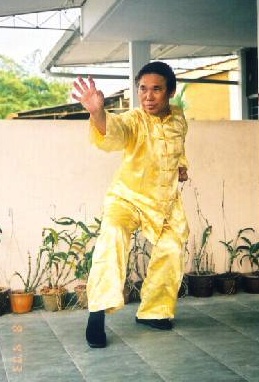
The forearm is referred to as a "bridge-hand" in kungfu terminology
Question 7
I emailed to attend one of your healers' courses to overcome rheumatoid arthritis. Your secretary suggested I contacted your website and have a healing with Grandmaster Wong. She said I would have to go to Malaysia. I would if it's my only option as traveling is very hard for me these days. In the last month I seem to be getting worse, fast.
— Birdie, USA
Answer
My Chi Kung Healing Course is meant to train chi kung healers, not for healing patients. Those who wish to be healed through chi kung training should attend my Intensive Chi Kung Course.
I would strongly recommend that you attend my Intensive Chi Kung Course in Malaysia. Please apply to my secretary at secretary@shaolin.org This is your best choice of action to overcome your rheumatoid arthritis.
Please take note that it does not mean that by attending the course your rheumatoid arthritis will be overcome straight-away. You have to continue to practice some simple chi kung exercises you have learned at the course for about 15 minutes a session twice a day. Your rheumatoid arthritis and other health problems if you have any should be overcome in a few months. You will also have more vitality and find life a joy everyday.
In the past I used to tell people with so-called incurable diseases to learn genuine chi kung. But they never overcome their diseases because they always ended up learning gentle physical exercise instead, and both they and their instructors did not realize the difference between genuine chi kung and gentle physical exercise.
So to save them time and effort, I told people with so-called incurable diseases to learn from certified Shaolin Wahnam instructors or healers, or to attend my Intensive Chi Kung Course. As a certified Shaolin Wahnam healer has recommended that you attend an Intensive Chi Kungfu Course, it means your disease is quite serious. The best course of action is for you to attend my Intensive Chi Kung Course.
It may not be easy for you to attend the course. As your disease is considered incurable, it is unlikely you will get well elsewhere. I don't mean to be presumptuous, but I am just telling the truth frankly. However, you have a good chance of getting well and a certainty of having a better quality of life by attending the Intensive Chi Kung Course. It is your choice.
Question 8
I am a reader and practitioner of your work, "The Art of Chi Kung", a book that I consider magnificent and everyone should have.
In this book you mention amongst other exercises, a practice called Absorb Moon Essence of the respected Chinese doctor, Chao Yuan Fang, which I would like to incorporate into my practice, but I just do not quite understand how to do it well. Do I have to practice the exercise at full moon, crescent moon, etc.
Is it necessary to practice precisely the time the moon set or anytime, and how many times I have to do the exercise? May I ask if you would be so kind to detail it? I greatly appreciate the attention to this mail, I hope for your valuable response and I send a cordial greeting.
— Gabriela, Mexico
Answer
Thank you for your kind words about my book, “The Art of Chi Kung”. Many other people too have kindly consider it a magnificent book.
Regarding the exercise recommended by the famous Chinese doctor, Chao Yuan Fang, the essence of the exercise is to draw lunar or moon energy. It is not very important at what date of the night you perform the exercise. But you will get the best result when the moon is full and when the moon is new, i.e. the first night and the fifteen night of the lunar month. As you have to draw lunar energy, it is obvious that you need to perform the exercise at night, and not in the daytime. It is also not very important at what time of the night you perform the exercise, but the best time is between 11 p.m. and 1 a.m. at midnight.
You can draw the moon energy for any suitable number of times. A recommended number is between 10 and 20 times. You draw the moon energy by gently breathing in through your nose and gently breathing in through your mouth facing the moon, or facing the direction of where you think the moon is if it does not appear clearly in the sky. It is best if you can bend your body or your head so that the two holes of your nostrils face the moon. It this is too tiring, you can stand upright. For those who are old or weak, they may sit on a chair.
This exercise is excellent for improving a woman’s fertility. Two other chi kung exercises excellent for improving a woman’s fertility are “Pushing Mountain” and “Nourishing Kidneys”. You can find them in my chi kung book. These two exercises are also excellent for many other benefits.
It is common among conscientious students to think that any exercise must be performed perfectly, and that any deviation from perfection would bring harmful result. I too had this wrong perception when I was a student. Later I discovered that this was not so. This does not mean that we can practice an exercise wrongly, but there is much room for variation. For example, one student may perform the exercise 15 times, and another student perform it 20 times, and both are correct. One student may bend his body at about 45 degrees and another at about 30 degrees, and both are correct.
There are, nevertheless, some very important rules that apply to all chi kung exercises, unless it is stated otherwise for a few particular exercises, as follows:
- Practitioners must not tense any muscles.
- Breathing must be gentle. Do not suck in air, and do not blow out air. Just breathe in and out gently.
- Do not think of anything. Gently focus on what you are doing.
A main reason why more than 80% of those who practice chi kung do not derive any chi kung benefits, like overcoming illness, having good health and mental clarity, although they perform genuine chi kung techniques is because they do not follow the very important rules mentioned above. These people practice genuine chi kung techniques as gentle physical exercise, just as many people practice genuine Taijiquan techniques as Taiji dance.