
TWO COMBAT SEQUENCES TO HANDLE MOST ORDINARY OPPONENTS
Many other people may find it hard to believe and think that we say non-sense, but if you are skilful in these two combat sequences and their variations, you can handle most ordinary opponents!
In sparring after you have completed a sequence in your attack, you can continue with the same sequence or with another sequence. This is the basic from which you can have a lot of fun, and combat efficiency, with "Subtraction and Addition".
Other people may find it hard to believe, but if you just practice this "Subtraction and Addition" on the two combat sequences for a few months and become skillful, you can handle most ordinary opponents irrespective of the kungfu styles or other martial arts they practice.
Starting the Fun in Our Sparring Methodology
You may initiate with Combat Sequences 1 and then continue with Combat Sequence 2. This is called “Continuation” in our sparring methodology. By varying the procedure, not only we can have some variey in our attack, we can also have much fun.
 Variations of Attacks from the Two Sequences
Sifu Michael Chow now uses the same attack sequence, which is composed of Combat Sequences 1 and 2. We can proceed to other variations. Instead of the initiator continuing after the first sequence, the responder can do so.
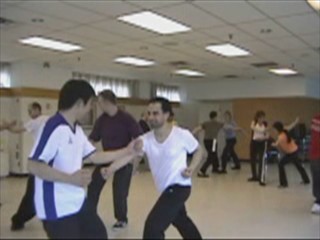 Prerequisite for Applying Sequences
Participants practice what they have just learnt. In the foreground are David and Joe. As the main objective of this session is to familiarize themselves with the routine of the sequences, they suspend the use of force and speed. Knowing the routine well is a pre-requisite for applying the sequences in free sparring.
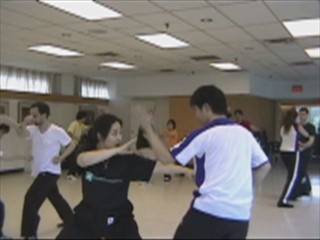 The Possibility of Change in Prescribed Procedure
Participants continue their practice of the “Continuation” method. In the foreground are Sifu Emiko Hsuen and David Ko, who are both former wushu international champions. In this session, Sifu Emiko follows the prescribed procedure. Later she may, if she likes, change to another procedure.
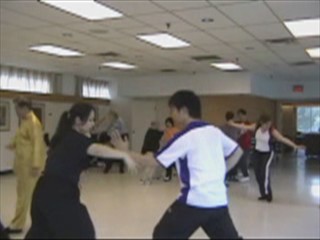 Spontaneity and Fluidity of Movements
This video clip shows the same practice session as the previous video clip. Even within one session, there is marked improvement in the spontaneity and fluidity of movements, which is a prerequisite for combat efficiency. Sifu Emiko and Davidd are advanced practitioners, so their rapid progress is expected, but this serves as an inspiration to students, reminding them that their performance after a month of practice should show some improvement.
 Spontaneity and Fluidity of Movements
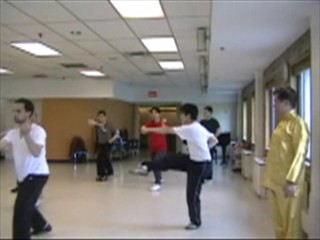
The class performs Combat Sequences 1 and 2 in “continuation”. The form of the patterns, including that of the junior students, is reasonably good. Picture-perfect form is a pre-requisite for performing a sequence well. If you have not attained this, you should go back to the basics like stances and footwork, and body movement.
Two Combat Sequences to Handle Most Ordinary Opponent from Wong Kiew Kit on Vimeo.
LINK
Review of Shaolin Tantui
12 Sequences of Tantui
Tantui in Picture Series
Combat Application of Tantui
Treasure House of Kungfu Sets
Treasure House of Combat Application